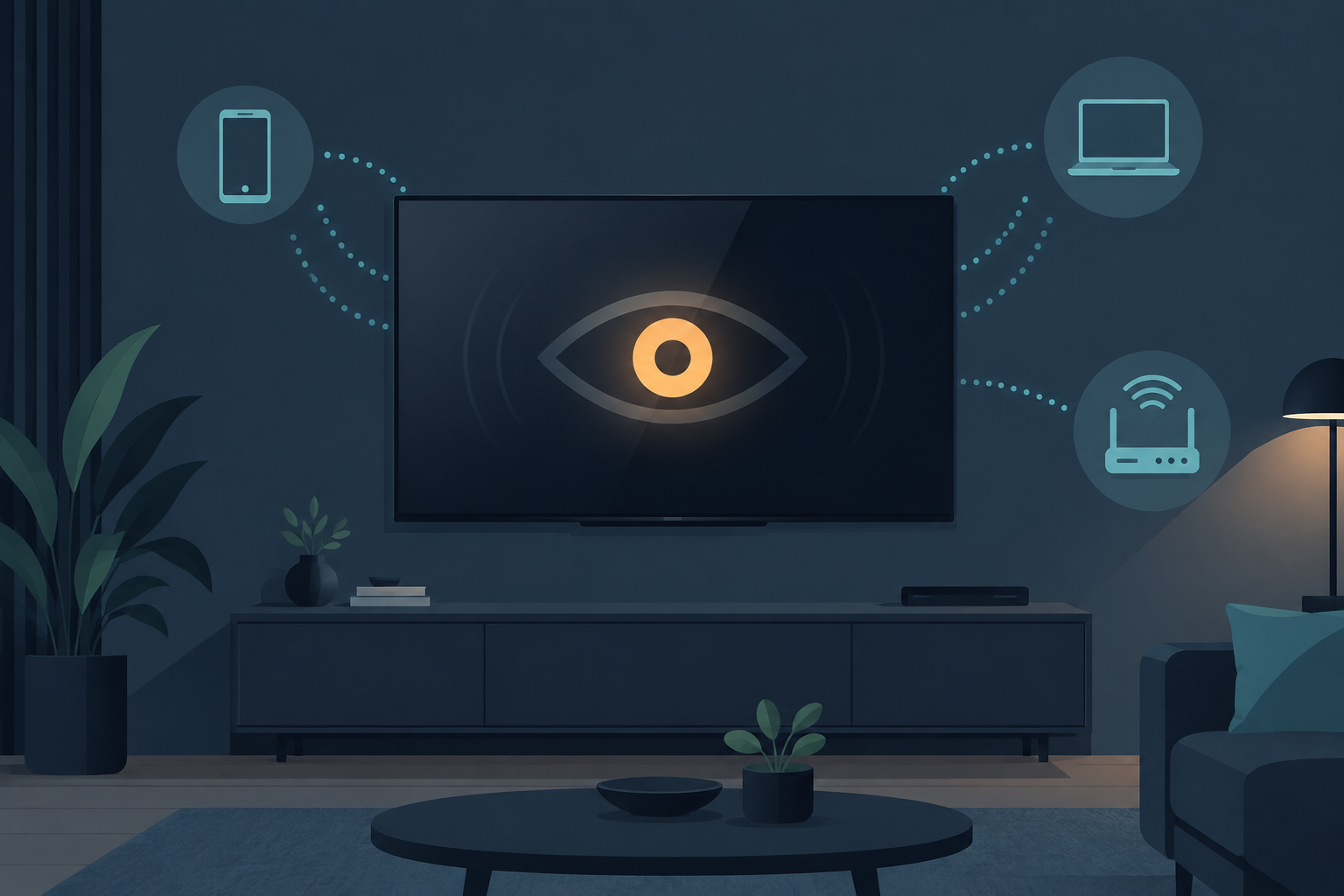
Your TV may know more about your household than your router does. That is not a joke. It is the claim behind a new investigation into LG smart TVs, and it has a lot of people digging through their settings.
Security researchers and the YouTube channel Gamers Nexus spent months testing retail LG OLED televisions. What they found raises hard questions about what a connected TV collects, where that data goes, and whether you ever really agreed to it. LG says the claims are wrong. The truth sits somewhere in the middle.
Here is what happened, what LG and regulators say, and the steps you can take today to keep your smart TV from knowing too much.
What Happened
In early September, Gamers Nexus published a two-hour investigation titled 216,000,000 Spy TVs. The channel worked with Level1Techs and independent security researchers. They bought retail LG OLEDs and watched the traffic leaving them.
According to The Verge, the findings include:
- The TVs scan your local network looking for other devices, including phones, smartwatches, printers, switches, and smart home hardware.
- They log location data and details about nearby Wi-Fi networks, including network names and signal information.
- They send that information back to LG Ad Solutions.
- They record audio logs through their microphones.
- They use audio and video sampling to identify what you are watching, in the TV’s own apps and across HDMI inputs.
That last one is called Automatic Content Recognition, or ACR. It samples what is on screen or in the room, builds a digital fingerprint, and matches it against a reference database. It can identify shows, ads, and viewing habits.
The most alarming claim is that the TVs keep logging and uploading even when they are offline or in standby mode.
What Is Happening Now
LG pushed back hard. In an official statement, the company said its TVs do not continuously record or transmit users’ conversations. Speech-to-text starts only when someone activates voice interaction through a wake word or the remote’s voice button. Audio used for wake-word detection stays on the TV, and if no wake word fires, it is not turned into text, stored, or sent anywhere.
On ACR, LG says the technology uses audio fingerprinting through the TV’s internal audio processor. The company states it does not collect screenshots, screen recordings, video recordings, or audio recordings. LG also says ACR, voice recognition, and interest-based advertising are optional, off by default, and that consent can be withdrawn in settings. The company calls the snooping concerns not true.
This is not happening in a vacuum. The Texas Attorney General’s office settled with LG Electronics U.S.A. earlier this year over ACR data collection. Under that agreement, LG must stop using ACR to collect viewing data without informed consent, show a pop-up disclosure explaining the practice, offer a clear opt-out, and keep viewing data from being transferred to the Chinese Communist Party. Texas reached a similar settlement with Samsung, and cases against Sony, Hisense, and TCL remain open.
Malwarebytes notes that some of the researchers’ findings relate to how LG intended the TVs to work, while others depend on vulnerabilities still being disclosed responsibly. Their conclusion is the one that matters for anyone running a business: a smart TV deserves the same privacy and security scrutiny as any other internet-connected computer.
What This Means for You
Start with the mental model. A modern smart TV is a computer with a microphone, an app store, an advertising system, and a seat on your home network. It sits next to your laptops, phones, and printers. When it scans the network, it can see them.
On its own, a list of nearby devices looks harmless. Combined with ACR data, advertising IDs, and location information, it starts to build a detailed profile of what your household watches, when, and what else lives on your network.
For a home, that is uncomfortable. For a business, it is a real risk. Conference room TVs hear meetings. Waiting room TVs see customers. Office guest networks often carry a television alongside vendor laptops. None of that belongs in an advertising database.
ACR is not an LG-only issue. A separate investigation from RTINGS found that nearly every smart TV maker uses the technology. If you own a Samsung, Vizio, TCL, or Hisense set, the same advice applies.
What You Can Do Now
You do not need to throw the TV away. You need to turn off what you never agreed to and separate the TV from anything that matters.
- Turn off ACR. On LG TVs, go to Settings, then Privacy and Terms, then Viewing Information. Some models list it as Automatic Content Recognition. Switch it off.
- Kill the other data features. In the same Privacy and Terms menu, disable Device Usage Data, Collect App Usage Data, and Live Plus. Each one feeds a different profile.
- Disable voice features if you do not use them. If you never press the voice button, the microphone has no reason to be armed.
- Put the TV on its own network. Create a guest Wi-Fi network or a separate VLAN for televisions and streaming devices. Then, when the TV scans for nearby hardware, the only things it finds are other TVs.
- Skip the smart interface. A streaming stick kept current by its own vendor often tracks less than a five-year-old TV firmware. Plug the stick into an HDMI port and use the TV as a display.
- Patch the firmware. Several reported issues involve security weaknesses. Check for updates and install them.
- Read consent screens when they appear. LG’s Texas settlement means clearer disclosures and easier opt-outs are coming. Read them instead of clicking through.
Closing
The LG story is not really about one manufacturer. It is about what smart has meant for the last decade: a device that watches you back. Research and regulatory pressure are pushing these companies toward clearer consent and simpler controls. Your job is to use them.
Take fifteen minutes this week. Open the privacy settings on every TV in your home or office and turn off what you never asked for.
Call to Action
Not sure how your office network is segmented, or what your smart devices are talking to? Digital Solutions of Chillicothe can help you find out. We plan, secure, and support technology for small businesses without making it harder than it needs to be.
Sources
- The Verge: LG smart TVs accused of logging data even in standby
- LG Newsroom: Statement: Understanding privacy on LG smart TVs
- Texas Attorney General: Agreement with LG to protect Texans’ privacy
- Malwarebytes: LG TV flaws could let attackers listen in
Primary keyword: LG smart TV privacy